
TrailEasyf0de7e94…894e
Neo-Gothic Trail Wiesbaden
Explore Wiesbaden's Gothic Revival marvels
5 StopsEstimated Duration: 64 minutes
The 'Gothic Revival in Wiesbaden' trail takes you on a 3.22 km journey highlighting stunning examples of Gothic Revival architecture. Starting and ending at the Friedenskirche, a masterpiece by Max Schröder, the route leads you past St. Bonifatius with its imposing towers that define Luisenplatz, and St. Augustine’s of Canterbury, a cherished site for the English-speaking Anglican community. Before returning to the Friedenskirche, you'll encounter the striking Bergkirche in the Bergkirchenviertel. This walk lets you experience the richness and diversity of Wiesbaden's Gothic Revival architecture.
Did you know? — Friedenskirche
Architect Max Schröder designed the church in the Gothic Revival style.
Listen
English
 English
Neo-Gothic Trail Wiesbaden — English
0:000:48
Trail Route
Route and stops
Walking routeConnector distances follow the accepted pedestrian network route. This is a route overview, not turn-by-turn navigation.
Live next-stop guide
Your location stays in this browser and is used only while the guide is on.
1
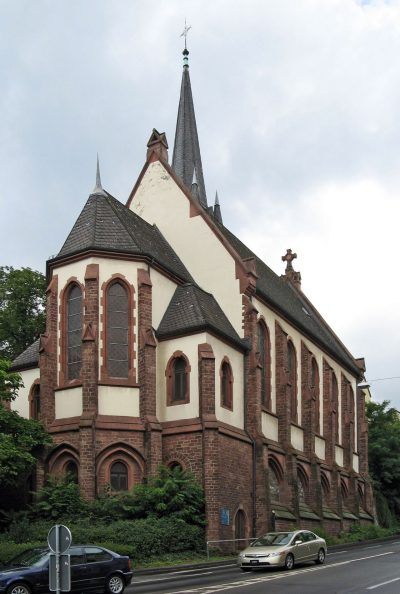
Friedenskirche
Place of worship
888 mStop 1 to stop 2
2
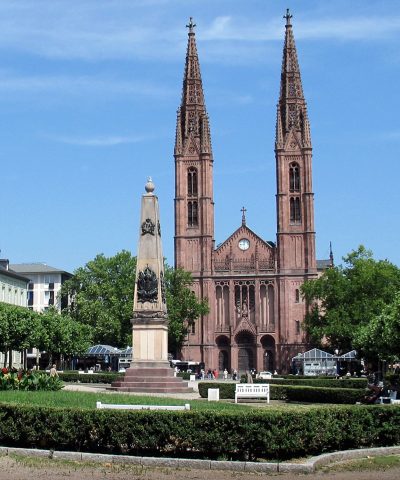
Sankt Bonifatius
Place of worship
592 mStop 2 to stop 3
3
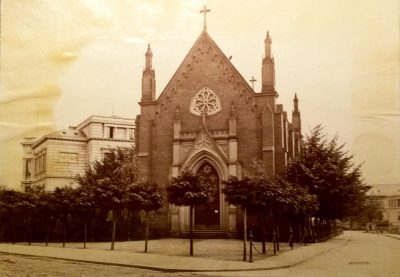
Church of St Augustine of Canterbury
Place of worship
410 mStop 3 to stop 4
4
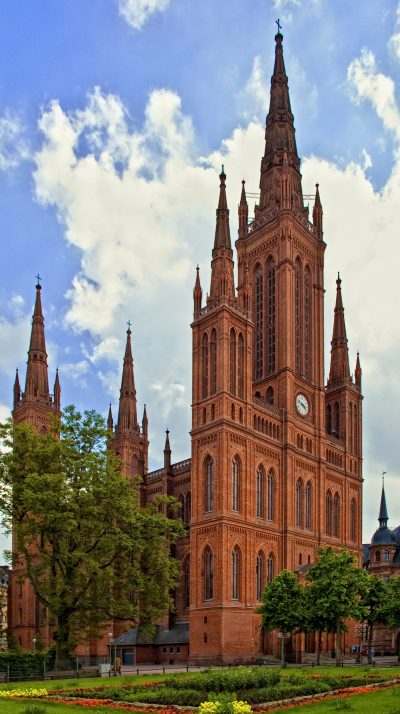
Marktkirche
Place of worship
766 mStop 4 to stop 5
5

Bergkirche
Place of worship
567 mStop 5 back to stop 1
Evidence and review:
- AI-generated
- Automatically approved by policy
- Not editorially reviewed
More trails in Wiesbaden


Image credits
- Neo-Gothic Trail Wiesbaden (header image): © Laurenz (CC BY 2.5) · Wikimedia Commons
- Friedenskirche: © Oliver Abels (SBT) (CC BY 2.5) · Wikimedia Commons
- Sankt Bonifatius: © TMg (CC BY-SA 3.0) · Wikimedia Commons
- Marktkirche: © asspixx.de selbst fotografiert und bearbeitet, nachbearbeitet Regi51 (CC BY-SA 2.0) · Wikimedia Commons
- Highlights of Wiesbaden: © Ygrek (CC BY 2.5) · Wikimedia Commons
- Industrial-Era Wiesbaden: © Wolfgang Pehlemann (CC BY-SA 3.0 DE) · Wikimedia Commons